+86-15362608169
For wholesale buyers, choosing the right Thermal Label Sticker Roll is rarely a simple price comparison. Roll width, core size, winding direction, adhesive strength, and printer compatibility can affect every shipment. A roll that looks economical may create jams, faded barcodes, or wasted labels during a busy packing shift. Small details become expensive at scale.
Mike Fairley, a respected label-industry analyst and educator, has said, “A label is more than decoration; it is part of the product’s communication.” This principle matters in 2026. Thermal labels now support warehouse tracking, retail identification, shipping, healthcare administration, and inventory control. Buyers need consistent print quality, clean die-cutting, reliable adhesives, and packaging that protects rolls from moisture and dust.
Do not trust a sample alone.
A serious wholesale evaluation should examine the complete supply chain. Confirm the face material, coating, adhesive performance, roll length, carton protection, and quality-control process. Test labels on the actual printer, especially after storage in heat or humidity. Direct thermal stock may suit short-term shipping labels, while thermal transfer stock can offer stronger durability for longer use. The correct choice depends on the application, not the sales description.
There is no universal best roll. That is the uncomfortable part. A low-cost option can be practical, yet it may fail under cold storage or rough handling. A premium product can also disappoint when matched with the wrong printer settings. This guide compares the 2026 best Thermal Label Sticker Roll options for wholesale buyers, using practical performance, supplier reliability, and total operating cost as the central measures.
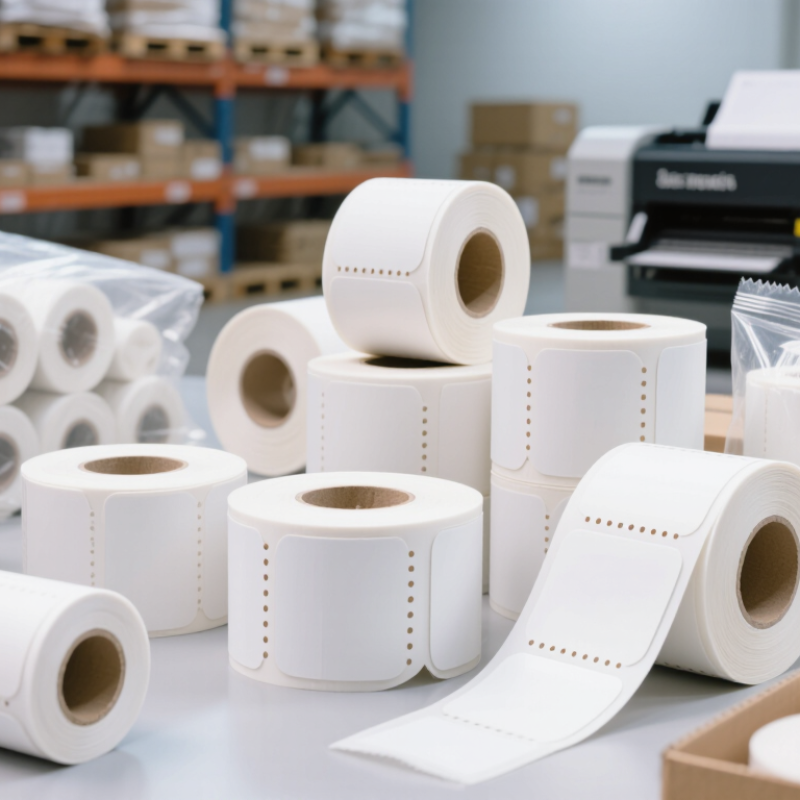
Thermal label sticker rolls combine pressure-sensitive labels with a heat-reactive printing surface. They do not require liquid ink or toner. A thermal printer applies controlled heat through tiny elements on its printhead. The coated label darkens where the heat touches it, forming text, barcodes, or simple graphics.
The roll stays wound around a paper or plastic core. During printing, the printer pulls each label forward using gaps, black marks, or continuous backing. Correct sensing matters. If the printer reads the spacing poorly, labels may shift or print across two stickers. That small error can waste an entire roll.
Most roll labels use direct thermal material for shipping, receipts, storage bins, and short-term identification. Heat, sunlight, moisture, and friction can gradually fade the image. Thermal transfer labels use a separate ribbon and usually offer stronger long-term resistance. Wholesale buyers should check width, length, core size, adhesive strength, surface finish, and printer compatibility before ordering large quantities.
A practical test should include cold storage, warm shelves, and rough handling. Check whether the corners lift after twenty-four hours. It is easy to focus only on roll price. That can be misleading. A cheaper label may create jams, weak scans, or extra waste. One detail is often overlooked: adhesive performance changes across cardboard, plastic, and dusty surfaces. Testing several cartons first is safer than trusting a specification sheet alone.

2026 Best Thermal Label Sticker Roll for Wholesale Buyers
High-quality thermal labels start with the face material, not the carton design. Direct thermal paper needs a smooth, heat-sensitive coating for sharp barcodes and readable small text. Smithers’ Future of Thermal Printing report identifies logistics, retail, and healthcare as major demand drivers through 2028. These applications punish weak coatings. A faded barcode can delay a shipment.
Choose paper with a balanced topcoat. It should resist light moisture, friction, and brief heat exposure. Phenol-free thermal coatings are increasingly preferred for safer handling, but buyers should request written material declarations. Grand View Research estimated the global thermal paper market at about USD 4.6 billion in 2023, with continued growth expected through 2030. Thermal labels represent only part of that market, so the figure needs careful interpretation.
Adhesive performance matters just as much. Permanent acrylic adhesive usually handles cardboard, plastic totes, and smooth warehouse surfaces well. Test it on the actual package. Cold storage can reduce initial tack. The liner should release cleanly without curling the label. Rolls also need even edges, firm winding, and a core matching the printer. I would test ten rolls, not one. That is less convenient. It is more honest. Measure barcode grades, peel adhesion, print darkness, and storage stability before approving a wholesale order. ASTM and ISO-based testing can make supplier claims easier to verify.
Key materials and features of high-quality thermal labels are compared below using representative midpoint specifications from common commercial label stocks. Actual performance varies by adhesive, coating, printer settings, and application conditions.
Buying insight: Paper stocks are cost-effective for short-term indoor labeling, while polypropylene and polyester provide better moisture, abrasion, and temperature resistance for demanding applications.
Choosing the right thermal label roll in 2026 starts with the application, not the lowest quote. In wholesale purchasing, I check the printer model, core diameter, roll width, and maximum outer diameter. A roll that looks economical may stop production if it does not fit the printer. Measure the label gap, liner thickness, and winding direction before ordering. Small details cause expensive delays.
Adhesive selection depends on the surface and storage conditions. Permanent adhesive suits clean cardboard and smooth plastic. Removable adhesive works better for temporary bins, shelves, or reusable containers. Cold rooms, dusty cartons, and curved surfaces need practical testing. Request samples and apply them for several days. I have seen strong adhesive fail when moisture covered the carton. Temperature claims should be verified, not simply accepted.
Direct thermal labels suit short-term shipping, receipts, and warehouse tasks. They print without ribbons, which reduces setup time and waste. However, heat, sunlight, and friction can darken or fade the image. Thermal transfer printing offers better durability for long-term identification. It requires compatible ribbon material and closer process control. For large orders, test barcodes, small text, and label removal by hand. A perfect first sample can still hide production problems. That is worth remembering.
For wholesale buyers, thermal label rolls should be compared by usable cost, not carton price. Pitney Bowes’ 2024 Parcel Shipping Index recorded 22.4 billion U.S. parcels in 2023 . That volume keeps demand strong for 4 × 6-inch shipping labels . However, roll count, core size, liner quality, and adhesive performance change the real value.
Typical wholesale quotes range from about $0.02 to $0.08 per label depending on material, order volume, and customization. Suppliers may require 10 to 100 cases per order. Some offer lower prices but add setup fees, freight charges, or strict payment terms. Ask for a production sample first. Test it on your actual printer, scanner, and storage cartons. A label that curls after two weeks creates hidden labor costs. I once overlooked core diameter. The rolls did not fit the warehouse printer.
Tips: Request a written quote showing labels per roll, rolls per case, minimum order quantity, lead time, and delivered cost. Check adhesive strength on corrugated boxes and plastic mailers. Also ask for batch consistency and replacement terms. Industry packaging forecasts from Smithers continue to identify e-commerce fulfillment as a major demand driver, but forecasts are not purchase guarantees. Your monthly usage may be lower than expected. Start with a trial order, then negotiate tier pricing using verified consumption data.
For wholesale buyers, thermal label quality starts before printing. Smithers’ 2024 labels market analysis projects annual growth of about 4% through 2028. That growth increases pressure on suppliers to deliver consistent rolls, not merely low prices. Each production batch should be checked for core diameter, roll width, winding direction, adhesive coverage, and barcode readability. Test the first and last labels from several rolls. Small differences can expose coating or tension problems.
Thermal coating should print dark, evenly, and without gray background noise. Measure optical density when possible. A practical acceptance target is often near 1.0 or higher for clear barcode contrast, but the printer and scanner still matter. GS1 guidance emphasizes sufficient contrast and quiet zones for reliable scanning. Inspect labels after rubbing, folding, and brief heat exposure. Some failures appear only later.
Storage deserves equal attention. ISO 18925 guidance supports controlled conditions near 20°C and 50% relative humidity for imaging materials. Keep cartons off concrete floors, away from sunlight, heaters, solvents, and heavy vibration. Use older stock first. Leave labels sealed until needed. In real warehouses, this is easy to say and harder to maintain. A humidity logger helps reveal weekend or seasonal changes. Do not stack cartons beyond their compression limit. Curled edges, blocked rolls, and fading are often storage problems, not printing problems.
| Evaluation Dimension | Recommended Bulk Specification | Quality Check for Buyers | Practical Acceptance Guidance |
|---|---|---|---|
| Label Material | Direct thermal paper with a smooth, uniform coating | Inspect the surface for pinholes, streaks, coating gaps, wrinkles, and uneven gloss | The face stock should be clean, flat, and free from visible coating defects |
| Common Label Sizes | Typical formats include 100 × 150 mm, 102 × 152 mm, and 100 × 100 mm | Measure label width, height, corner radius, and gap using a calibrated ruler or gauge | Allow dimensional tolerance to be agreed in the purchase specification before production |
| Roll Winding | Tight, even winding without telescoping, loose edges, or crushed layers | Place rolls on a flat surface and check side edges for shifting or deformation | Reject rolls with severe edge damage or irregular winding that may cause feeding problems |
| Core Size | Common core diameters are approximately 25 mm, 40 mm, or 76 mm, depending on printer type | Measure the internal diameter and confirm compatibility with the target printer spindle | Core dimensions must match the printer or dispenser; an incorrect core can prevent stable feeding |
| Print Contrast | Sharp black image and text at the printer’s normal operating speed | Print a sample barcode, small text, and solid blocks at standard and faster settings | Text should be legible and barcodes should scan consistently without excessive heat or darkness |
| Barcode Scannability | Consistent contrast across the entire printable area | Scan samples from the beginning, middle, and end of several rolls | Test multiple batches because coating uniformity can vary between production lots |
| Adhesive Performance | Permanent or removable adhesive selected for the application surface | Apply samples to clean cardboard, plastic, and other intended surfaces; check initial tack and edge lifting | Adhesion depends on surface energy, temperature, dust, moisture, and application pressure |
| Release Liner | Flat liner with consistent release and no adhesive transfer | Peel several labels at different points in the roll and inspect for tearing or adhesive residue | Labels should dispense smoothly without excessive force or liner splitting |
| Perforation and Gaps | Uniform perforations or inter-label gaps suited to the printer sensor | Check gap consistency and verify that the printer detects each label correctly | Irregular gaps may cause skipped labels, misalignment, or repeated calibration |
| Roll Length and Quantity | Quantity per roll and rolls per carton clearly stated on the packing list | Count labels on sample rolls or verify length by controlled measurement | Set an agreed quantity tolerance and identify any short rolls before shipment acceptance |
| Moisture Protection | Sealed inner packaging with protective outer cartons | Inspect packaging for punctures, condensation, water marks, and crushed cartons | Keep labels dry; moisture can affect curl, adhesive behavior, and print consistency |
| Storage Temperature | Stable room-temperature storage, commonly around 18–25°C | Review warehouse records and avoid locations near heaters, loading doors, or direct sunlight | Avoid prolonged heat exposure because direct thermal coating may darken or lose performance |
| Relative Humidity | Moderate, stable humidity, generally around 40–60% RH | Use a warehouse hygrometer and check for curled edges or softened packaging | Avoid high humidity, rapid humidity changes, and direct contact with floors or exterior walls |
| Light Exposure | Opaque cartons or covered storage away from ultraviolet and strong visible light | Check outer cartons for light exposure and inspect stored rolls for premature discoloration | Store in a dark or shaded area to help preserve image quality before use |
| Stacking and Handling | Keep cartons level, supported, and protected from compression | Look for crushed cores, flattened rolls, and carton deformation during receiving inspection | Do not throw, drop, over-stack, or place heavy goods on thermal label cartons |
| Inventory Rotation | First-in, first-out handling with batch and receipt dates recorded | Compare warehouse labels, purchase dates, and production batch information | Use older stock first and avoid storing bulk rolls beyond the supplier’s recommended shelf life |
| Receiving Inspection | Sampling plan covering packaging, dimensions, print, adhesion, and quantity | Record defects by carton, roll, batch, and defect type with photographs where necessary | Approve shipment only after results meet the agreed purchase specification |