

 +86-15362608169



Industry News
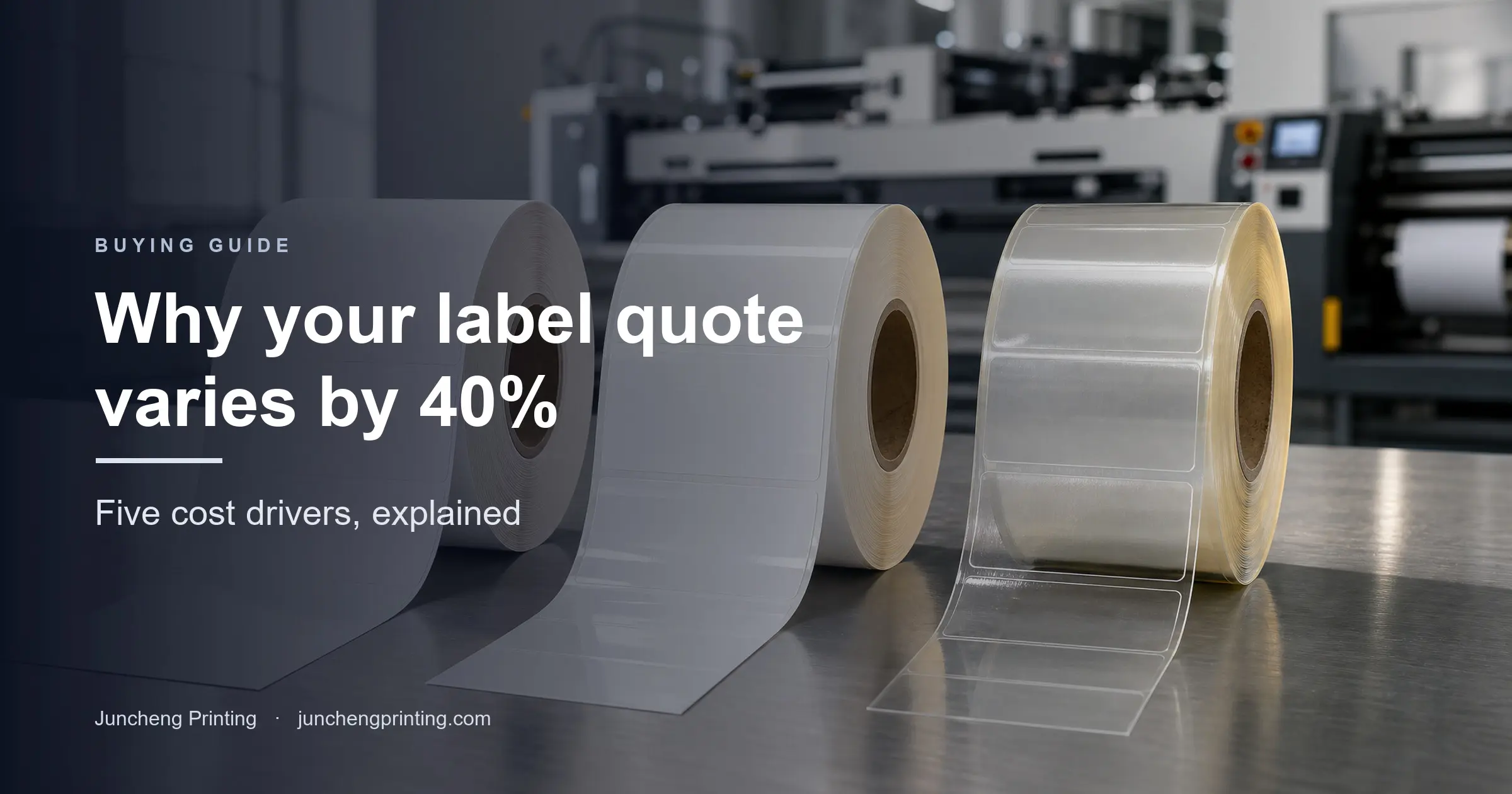





Why Your Label Quote Varies by 40%: Five Cost Drivers, Explained
2026-11-05
Two suppliers quote the same brief and the numbers land 40% apart. The instinct is to assume one of them is either overcharging or cutting corners. In most cases neither is true: the gap sits in the specification, not in the margin. A quote is the sum of five decisions — what the label is made of, how it is printed, how it is finished, how many you buy, and what has to be documented alongside it. Change any one of those and the price moves. Change three and a 40% spread is normal. This article breaks down each driver, shows where the money actually goes, and gives buyers a way to compare quotes line by line instead of staring at the total.
Figures below are indicative trade ranges for planning and comparison. They are not a quotation — a real price depends on your dieline, substrate availability, press loading and destination.
Driver One: Substrate Is Usually the Largest Single Lever
Face stock, liner and adhesive together typically account for the biggest share of a pressure-sensitive label's cost, and they are also where two quotes most often diverge without either supplier mentioning it.
Paper face stocks are the cheaper default for dry goods, cartons, logistics and retail price labels. Film stocks — PP, BOPP, PET — cost more per square metre but survive moisture, oil, refrigeration and handling that destroy paper. A freezer-grade adhesive is not the same chemistry as a permanent general-purpose adhesive, and a Removable Adhesive costs more again because it is formulated to fail cleanly.
The liner matters as much as the face. A standard glassine liner is inexpensive; a PET liner costs more but holds dimensional stability through tight-die cutting and high-speed applicators. If your line runs at 300 bottles a minute, the cheaper liner can cost more in downtime than it saves in material.
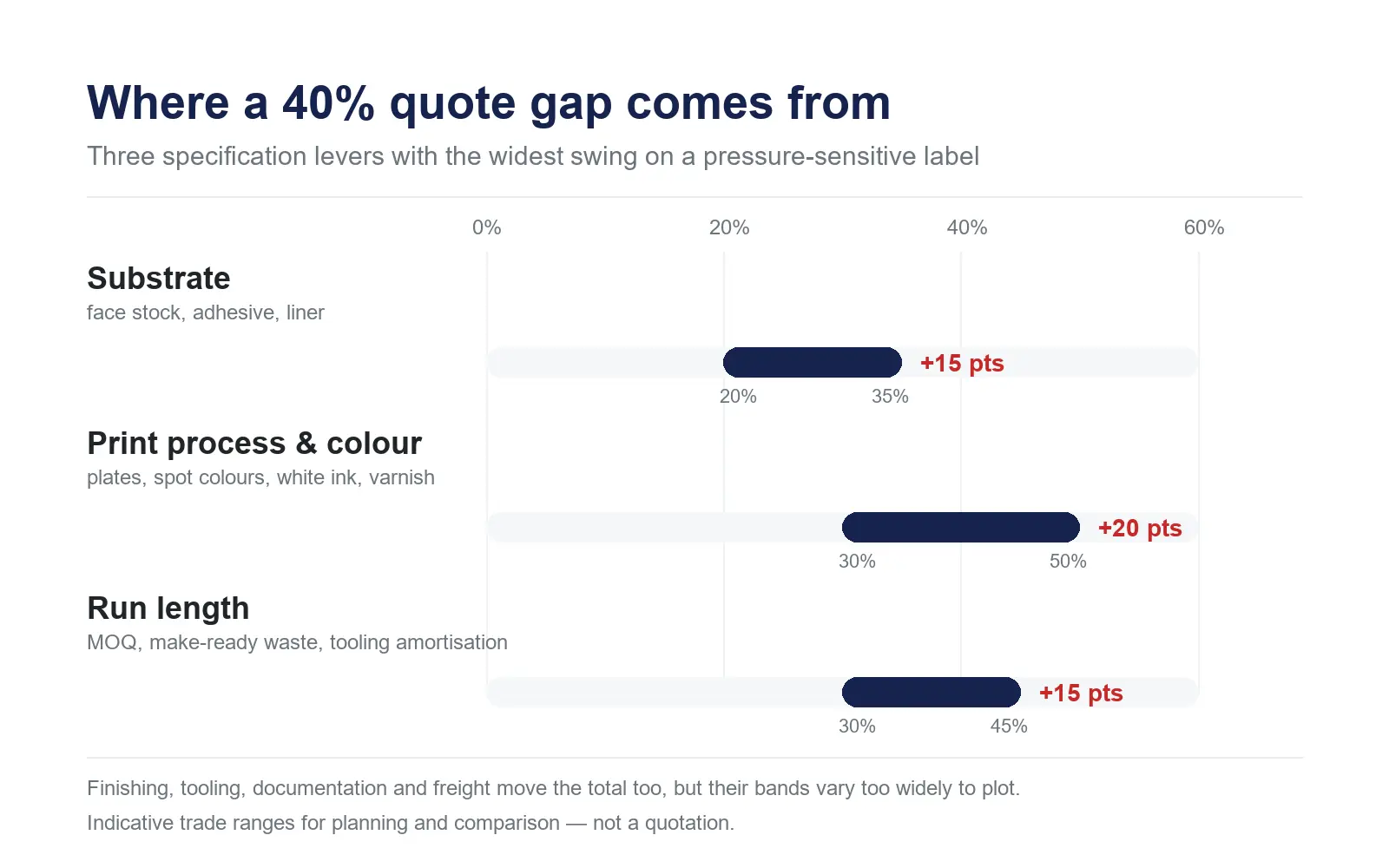
Two further swings: roll width (a non-standard width wastes parent-reel capacity) and certified stocks (recycled-content, compostable or FSC-certified papers carry a premium and longer lead times). On a typical label, moving from an economy paper/glassine build to a film/PET build with a specialty adhesive can move material cost by 20–35% on its own.
Driver Two: Print Process and Colour Count Set the Floor Price
Flexographic printing carries tooling — plates and cylinders — plus set-up time per colour. That cost is fixed, so it dilutes across volume: at 5,000 labels it dominates, at 500,000 it nearly disappears. Digital printing carries no plates but charges per impression through toner or ink and wear, so it wins on short runs, versioning and variable data, and loses on long runs.
The second variable is colour. Four-colour process is the baseline. Add a spot colour and you add a plate, a set-up and a wash-up; add white behind print on clear film and you effectively double the passes over that area, because white must be laid down opaquely before the colour sits on top. A varnish or matte lacquer is another station. A five-colour job with white and varnish is not "one more colour" than four-colour — it can be 30–50% more expensive on a short run.
Brand colour matching adds a further step: ink mixing, drawdowns and an approval loop. If the brand insists on a precise match on every reprint, budget for it permanently rather than treating it as a one-off.
Driver Three: Finishing and Tooling Are Where Quotes Quietly Diverge
Finishing covers everything after ink: die cutting, lamination, varnish, cold foil, embossing, slitting and inspection. Each adds a station, a set-up and scrap.
Die cutting is the most common hidden difference. A standard shape may use a stock die; a custom silhouette needs a die made, and that tooling is either charged upfront or amortised into the unit price. Two quotes that look comparable can differ purely because one includes the die and the other bills it separately at order confirmation.
Lamination and cold foil add material plus a pass through the press. Embossing needs a male and female tool pair. Then there is inspection: a 100% camera inspection station that rejects misregistered or missing labels adds cost, but it is the difference between a defect rate you can live with on a high-speed applicator and one you cannot.
Ask every supplier to list finishing as separate line items with tooling called out. If one quote is a single number, you cannot tell whether you are comparing the same product.
Driver Four: Run Length, MOQ and Waste Decide the Unit Price
Label Printing cost per thousand is not linear. It falls steeply at first, then flattens. The curve has three regions: below the minimum order quantity you pay for set-up you are not using; in the middle you amortise plates, dies and make-ready efficiently; at very high volume you hit material and capacity limits, and the savings become marginal.
Waste is the part buyers rarely see. Every run starts with make-ready: substrate threaded, registration dialled in, colour approved. That waste is real material and real press time, and it is priced into your order. Typical spoilage allowances run from a few percent on a stable long run to considerably more on short runs with tight tolerances or difficult film.
Over-runs and under-runs matter too. Suppliers often quote a tolerance of plus or minus 10%; if you need an exact count, say so, because exact counts mean extra inspection and extra waste. And if the label is stable, buying twelve months of stock can beat four quarterly reprints — but only if you have somewhere clean and dry to store it and the artwork will not change.
Driver Five: Artwork, Compliance Files and Freight Terms Finish the Job
Prepress is not free. Dieline creation, barcode verification to the right symbology and grade, trapping, step-and-repeat, multilingual versions and proof cycles all consume skilled time. A brief with one clean PDF and a defined dieline is cheaper to produce than one with a logo rebuilt from a screenshot and three language variants.
Compliance documentation has become a genuine cost line. Food-contact statements, material declarations, migration testing references, chain-of-custody certificates and — for EU-bound packaging — the technical documentation that supports a declaration of conformity all take time to assemble and maintain. Suppliers who already hold these documents price them in; suppliers who do not will either refuse the order or charge you for creating them.
Finally, freight terms change the landed cost without changing the label. Ex-works, FOB and delivered-duty-paid are three different numbers for the same carton. Air freight on a heavy paper label can add more than the printing. Duties and destination handling belong in the comparison, not in a separate email thread.
Worked Example: Same Brief, Two Specs, Two Quotes
A 60 × 40 mm wrap label for a 250 ml bottle, full-colour brand design, applied on an automatic line. Two specifications that a buyer might consider "the same thing":
Index the unit price at 100 for Spec A at 10,000 and the same brief in Spec B at 200,000 typically lands in a different order of magnitude on tooling but 30–45% lower per thousand on unit cost. Reverse the quantities — Spec B at 10,000 — and Spec B becomes the more expensive quote, which is exactly the situation where buyers conclude that "the expensive supplier is ripping us off". They are not. They quoted a different product.
How to Compare Label Quotes Without Getting Fooled
A quote comparison only works when both documents describe the same physical product. The six questions below force that alignment before price becomes the conversation, and they are the same questions a competent supplier will ask you unprompted.
- Ask for the same six line items from every supplier: substrate, adhesive and liner; print process and colour count; finishing with tooling separated; quantity and waste allowance; documentation included; freight terms.
- Insist on a dieline and a material data sheet attached to the quote. If a supplier cannot name the face stock and adhesive, the price is not comparable.
- Ask what happens at 50% and 200% of the quoted quantity. A supplier who can model the curve understands their own cost structure.
- Ask whether tooling is one-off or amortised, and who owns the die if you switch suppliers.
- Confirm the inspection standard and the acceptable defect rate in writing, especially if you run high-speed applicators.
- Compare landed cost, not unit price: add freight, duty, storage and the cost of your own re-inspection.
Frequently Asked Questions
Why is a digital label quote higher per unit than flexo at low volumes? Digital has no plates, so it wins on set-up, but its per-impression charge does not fall with volume the way flexo's fixed tooling does. Below roughly 5,000–10,000 labels the saved make-ready usually outweighs the higher running cost; above that, flexo's amortised tooling starts to dominate.
Does a higher order quantity always lower the unit price? No. Unit cost falls steeply, then flattens, and can even rise if the run exceeds available capacity or forces a material substitution. There is also a carrying cost to holding twelve months of labels, and a risk that the artwork changes before you use them.
What is the single biggest cost driver in a custom label? Substrate — face stock, adhesive and liner together — is usually the largest single line, followed by print process and colour count. Both are specification decisions, which is why two quotes for "the same label" can sit far apart.
How much does adding one spot colour add to a quote? On flexo it adds a plate, a set-up and a wash-up; on a short run that can be 10–20% of the total. On digital it adds a click charge rather than tooling. White ink on clear film is more expensive than a spot colour because it must be laid down opaquely before the colour print.
Can I compare two label quotes directly? Only if both were built on the same dieline, substrate, colour count, finishing, quantity, documentation and freight terms. Ask each supplier to restate the quote against the six line items above; most 40% gaps shrink or invert once the specifications are aligned.
This article is a buying guide, not a price list. Ranges are indicative trade bands; your quotation depends on dieline, substrate availability, press loading and destination. For a specification-level comparison, send your current label and target quantity and ask for the same six line items from every supplier you shortlist.